The story of St Angela's school

Monday, 23 May 2016


Forest Gate's growing mid-nineteenth century population was added to by an influx of Irish economic refugees, fleeing the potato famine (see here for examples).

The then Strafford Catholic priest, James McCoin was on the look-out for help in educating Catholic children, as a counterweight to the CofE and Non-Conformist education provided by local charity schools (see here, for  details of these schools and early formal education in Forest Gate).

In February 1862 he invited a party of four Ursuline nuns from Belgium to visit the Upton area (the more developed part of Forest Gate, at this time). The Ursuline order was one largely committed to education and had been seeking a base in England for at least a decade. They had previously sought bases elsewhere, including in Walthamstow - but to no avail.

Following their visit to Forest Gate, they acquired a semi-detached house with a large garden in Upton Lane, then described as "in the country village of Upton". They bought the adjoining house the following year, which together, in the St Angela's story, became known as "The Old House".


Some of St Angela's pupils, pre 1887,
 when school uniform first introduced
The pair of these houses appears to have been built almost two centuries earlier, in 1684, although few details of their earlier history seem to remain.

Unfortunately, neither does there appear to be any surviving images of the properties, prior to very extensive later alterations by the Ursulines. The houses were, initially, to be the nuns' convent. The four original nuns were soon  joined by four more.

On 28 May 1862 Mother Agatha and Mother Victoire began to teach in two cottages in Sun Row, as Green Street was known.  The following year the nuns had the stables in the convent converted into a school - a big improvement on Sun Row - and moved the teaching there.


First assembly hall, 1889 - 1914
The nuns continued to commission building in 1872. The first wing included a study hall (later library) - see photo, with classrooms and a dormitory above. Boarders moved in, leaving the dozen or so day pupils in The Old House.

In 1874 Mass began to be said in the school, thus saving the local faithful a weekly trip to Stratford - and continued until the church of St Antony's was built a short distance down the road in Upton.


The chapel, as it was in 1884
In 1875 a boys school - St Bonaventure's - was opened a few yards away
In 1882 a new wing was started at St Angela's and included a chapel and more classrooms.


1884 convent building
As an aside, it is quite remarkable how an area such as Upton, for so long a home to wealthy Quakers (the Fothergills, Frys, Gurneys, Pellys, Listers  etc - see later posts for details and their full widespread impact), within two decades had become the centre of a thriving Catholic community - spawning two schools, a convent and a church.


Sporty boarders at St Angela's, post 1887,
 but pre 1900 - note cricket bats on far left of photo
This small strip of land provides, in microcosm, the traditional role of the East End: a host to successive waves of immigrants and other outsiders, with one community - usually seamlessly and peacefully - replacing another. The "displaced" communities, typically, move on, usually in a diversified way, to more established and often more affluent areas elsewhere.

An early pupil described arriving at the school:
My first sight of Forest Gate was when the train drew up at a wooden platform, backed by a hedge, which displayed a placard: 'Forest Gate'. There was nothing to be seen but trees and a country road. Only one house did we pass on the way to the convent, and everything was still and silent.
The school building, itself, was homelike ... there was nothing but a notice-board to indicate it was a school.
Boarders' study hall, built 1884
 The school soon became a success - by 1893 it had a roll of 229 - which was quickly replicated elsewhere. So, in 1892, four of its nuns moved to Wimbledon to establish a school there, and in 1899 the convent took charge of the parish school of SS Peter and Paul in Ilford for a decade or so, and supplied nun/teachers to it for almost half a century.

The convent, photo 1902
The Upton convent spawned another successful school in Brentwood in 1910 and others followed in Billericay, Palmers Green and Becontree.


St Angela's grotto, pre-1914
Success for St Angela's meant growth, locally, too. By 1899 it had grown further and took possession of another wing in St George's Road.


St Angela's assembly hall, pre-1914
Upton had a reputation for hosting fine gardens. Dr Fothergill's house (which later became West Ham Park - see later posts) being the most prominent. The convent, too, was noted for the splendour of its gardens.
Convent garden, 1910

Children's garden, 1922
The twentieth century continued to see growth and change for St Angela's. It appointed its first secular mistress - Miss Harrington - in 1903. The following year it became one of the first Roman Catholic schools in the country to gain recognition from the government's Board of Education.


First science laboratory, opened 1907
By 1921 the school had 700 pupils, when Mother Xavier, who first became headmistress in 1878, retired. Four years later the Rosary Chapel was built "in thanksgiving for protection in the world war". The boarding system was phased out from 1931 and the dormitories were converted to general school use and a dormitory for the sisters.


St Angela's prep school, 1914
Internal reforms within the Catholic church soon saw the convent's novice nuns being transferred to Westgate-on-Sea and the convent itself began sending out - and receiving - missionaries from Africa, Asia and South America.

With the onset of the second world war, the school and its pupils were evacuated to Thetford in Norfolk and Newquay in Cornwall and the "Old House" was used as a public shelter for local people during the hostilities.


St Angela's evacuees potato
 picking in Newquay during WW2
The 1944 Education Act meant big changes for the school; in conjunction with West and East Ham councils, it set about doubling its size. It became truly comprehensive for the first time (a status that was not officially confirmed until 1976) and attracted pupils from over 20 Catholic parishes, in the wider East London area.


Aerial view, 1953
With this growth, support and recognition came a greater "professionalism" of teaching at the school. The number of sisters who taught there declined considerably - to be replaced by lay qualified teachers, although nuns continued to hold non teaching roles in both the school and wider community.

By 1980 there were only about 20 nun/teachers at St Angela's.

On 16 March 1982 a fire swept the sisters' dormitory quarters on a day when the girls, or "Brownies" (so called because of the colour of their uniforms) were not present. The damage was substantial and many of the nuns had to be re-located during the extensive restoration process.


Tentacles spread into Ilford
In 1993 Delilah Smith was appointed the school's first lay head, and remained in post until 2009. During that time she picked up an OBE for her work and saw the number of sixth form pupils soar from 300 to 800, in a collaborative partnership with the near-by St Bonaventure's.

St Angela's continues to prosper today and is designated "Outstanding" by Ofsted.

Public art in Forest Gate

Saturday, 14 May 2016


This post should be read in conjunction with the immediately previous one, on monuments in Forest Gate, that looked at; The Gurney Memorial in Stratford, the cairn in West Ham Park, The Joseph Fry water fountain on the corner of Capel Road and Wanstead Flats, the clock and drinking fountain, outside Forest Gate railway station and the synagogue memorial, in Earlham Grove.

This article features more recent installations.  Unlike the above mentioned, these are all made of less robust materials than stone. But like all of the stone monuments, there is also an on-going Samuel Gurney connection with them.


The Preacher - Woodgrange Methodist church


The Gurney connection, first!  The Woodgrange estate and much surrounding land was part of Samuel's local land portfolio, before it was gradually sold off by his grandson, following Samuel's death in 1856.

The statue of The Preacher protruding from the Methodist church on Woodgrange Road was recently awarded Grade 11 listed status by English Heritage, which inspired us to find out more about it.

As we have reported previously, the original Methodist church on Woodgrange Road was destroyed in the blitz, on 3 December 1940. When it was being rebuilt in the 1950's, its architects appointed Hungarian-born sculptor Peter Laszlo Peri to create a statue/wall relief on the main, front-facing,  wall of the main church building.


Peter Peri's The Preacher,
 Woodgrange Methodist church

The resulting "Preacher" was unveiled in 1961 and is described by English Heritage as: "A striking long-limbed figure, grasping a prayer book. It is made of a dark mixture of concrete, resin and metallic powders, mixed by Peri and dubbed "Pericrete".

Among Peri's other works are three sculptures on a housing estate in Vauxhall, dedicated to children who lost their lives in the blitz. They were created between 1949 and 1952.

Peri has an interesting personal history. He was born Ladislas Weisz in Budapest on 13 June 1899, of Jewish parents. The family changed its name in the early years of the twentieth century, to sound less Jewish, because of the rise of anti-semitism in the city, in the years leading up to the First World War.

Peter eventually fled persecution from Hungary in 1921, seeking refuge, ironically, in Berlin, where he began sculpting his revolutionary "Wall reliefs".

Peri and his wife subsequently became communists and fled to Britain after Hitler's rise to power. He settled in London and worked in studios around the capital - finally in Camden Town.

He was largely ignored by the British arts establishment during his lifetime, which some have put down to his communist sympathies. He became a British citizen in 1939 and took the name Peter Peri. He later became a Quaker.

Peri subsequently undertook a number of post-war commissions and participated in exhibitions and arts exhibitions throughout the 1950's. He died on 19 January 1967, as a largely ignored, or under-rated, artist.


Window and mosaic on Durning Hall


These are in Earlham Grove, once Gurney land and named after Earlham Hall, Norfolk - his birthplace. The window is the altar window of the Church of the Holy Carpenter and was designed by Shingler and Risden Associates.


Durning Hall alter window - 
designed by Shingler and Risden
The mosaic, according to tiles within it, was commissioned by Newham Council Leisure Services in 1996. It seems to celebrate the activities that took place within the community centre, at the time.

It appears to have been created by attendees at the Greenhill Centre, in Manor Park, according to tiles, within it.


1996 Durning Hall mosaic

If anyone has more details about these artworks, we, and the staff at Durning Hall, would love to hear about them.


Community painting on Balmoral Road bridge


This is situated on part of the former Hamfrith estate, which - of course - for a while was owned by Samuel Gurney.

According to a plaque on it, the artwork was created by the local community and "commissioned by the Mayor of Newham and local councillors" in July 2013, to commemorate a major piece of work to strengthen the bridge.


Balmoral Bridge community painting

The mural features representations of the local area, including Wanstead Flats, the clock tower and Rotunda on Woodgrange Road, next to the station as well as local forms of transport. One panel on it is dedicated to the names of some of those involved in its creation.

The mural replaces a former community mural, which was created, overwhelmingly, by children from Godwin and Woodgrange schools, which was damaged during the bridge strengthening. 


Meanwhile - Forest Gate Rail station


Other artwork from these two local schools could be found on the walls of Forest Gate station, on the bridge from the entrance to platform one.  This, doubtless won't survive the current refurbishment work being undertaken there at present.

Crossrail, however, have been swift to commission a piece of surreal art along the long brick wall adjacent to platform 4.  This was put up in two days by an Italian artist, who prefers to create under the pseudonym Bifido, rather than under his own name, and some co-workers/artists.


Bifido, and team, looking pleased with
 themselves, having created "Meanwhile"
 in mid March 2016
The piece, entitled "Meanwhile" is constructed from paper, tiles and glue, using a "paste-up" technique (otherwise known as the more down to earth "stick on the wall badly, then watch it start to peel off after a couple of weeks" technique, to most Forest Gate residents).  

The work features, among other objects, a giant snail, a man standing in a huge tea cup, and falling leaves, metamorphosing into butterflies, a few clocks and a train. Just out of vision, Salvador Dali can be sensed turning in his surreal grave.

Bifido describes the work, in a statement that is destined for Private Eye's Pseuds Corner, as:


Looking at the spectator waiting for his train: an everyday repetitive sense of wait clashes with the speed of the train. Wait and speed are concepts at the core of this eclectic narrative: they combine and relate in an oxymoronic way.


Hoarding, around the Community Garden, Earlham Grove


Until the new station artwork, this was Forest Gate's latest significant piece of public art, and of course it is situated on former Gurney land (see above for the connection)!

The Community Garden steering group held a public competition last spring, seeking a designer /artist to offer a proposal for illustrating the rather stark and dull hoardings that surrounded the under-construction garden.


Community Garden mural -Metamorphosis
- designed by Jim Valentine, painted by
 over 70 local people, 2015
The competition was won by local artist, Jim Valentine (see his website: here, for more details), for his work Metamorphosis. Over seventy members of the local community (named in a panel on the mural) took part in The Big Paint in September last year, to colour in Jim's design outline on the hoardings.

The mural proved to be a great success and a colourful addition to the local area. Unfortunately, some of the panels were blown down in a storm at the turn of the year.

There has been something of a stand-off between the Community Garden committee and local council over who will take responsibility for the damage and restitution.  Fortunately a way forward seems to have been agreed.

This will result in a replacement of some of the damaged panels, while leaving more openings in the fencing for public viewing of the rapidly developing garden project. This will be in response to local public demand which has sought better viewing facilities.

A date has yet to be fixed for the repair and restoration, but as the committee says: it is an ill wind ...

So, the last two posts have focused on a ghost running through them, a future post will address the life and Forest Gate times of Samuel Gurney.

Footnote: We have not covered any of the many memorials/prominent headstones/ sarcophaguses in Forest Gate's cemeteries in this post, they have been covered elsewhere in this site on a number of occasions. 

Nor have we included a number of other, smaller, items of public interest - often details on walls or reliefs on the faces of buildings. Many of these have been recorded in an interesting, though slightly dated, website: Exploring London. They can be accessed here.

Public monuments in Forest Gate

Friday, 6 May 2016


This is the first of two articles looking at monuments and public art in Forest Gate. There is an unexpected, unifying, theme running through almost all of them.

This article examines the chronologically earlier pieces, which are mainly the monuments, constructed from stone, of one variety or another. The next instalment will look at other public art forms, which have a much more temporary feel about them, as they have been created from less durable materials.

Below we provide a round-up of what is known of Forest Gate's monuments - sadly, in some cases, not much!


The Gurney obelisk and water trough on The Broadway,  Stratford


Although this is clearly not in Forest Gate, in a strange way it provides the link, which connects almost all the other monuments and art works covered in this and the following post.

Samuel Gurney (1786 - 1856) has probably been Forest Gate's most significant resident, and will be the subject of a future post on this site. He was one of Britain's most important 19th century bankers and lived in what is now West Ham Park.

He was brother to prison reformer, Elizabeth Fry, a prominent Quaker and played a leading part in anti-slavery work (including helping to fund the establishment of the African state of Liberia). Samuel was a significant figure in the story of education - both locally and nationally - and was a fierce public campaigner against capital punishment - an unpopular position to take at the time.


An 1861 drawing of the Gurney memorial,
 Stratford, soon after its erection in 1861
He was also a major local land-owner and towards the end of his life owned almost half of what currently constitutes Forest Gate.  Following his death in 1856, his grandson, who effectively inherited his estate, gradually sold much of it off.

From those sales came the establishment of a number of local cemeteries, the old industrial school, now residential accommodation on Forest Lane, the Woodgrange estate,  the "Forest Gate village" area, much of the housing to the west of Woodgrange Road, south of the railway, up to Atherton Road, as well as West Ham Park, itself.

The obelisk and water trough, outside St John's church in Stratford is 40 feet high and made of granite.  It was unveiled in 1861, having been designed by Gurney's fellow Norfolk-man, John Bell, whose other work can be seen decorating Kensington's Albert Memorial and the Museum of Childhood in Bethnal Green.

The inscription on it reads: "In remembrance of Samuel Gurney, who died on 5th June 1856. Erected by his fellow parishioners and Friends (members of the Quaker faith) 1861. 'When the ear heard him, then it blessed him'".

It has been a key landmark in the area for over a century and a half.

The cairn and water fountain West Ham Park


This monument, near the main entrance to West Ham Park on Upton Lane, is all that remains of Ham House - Gurney's former residence.  The cairn and fountain are constructed from rubble and remnants from the house, and located immediately in front of where it stood.


The cairn in West Ham Park, marking
 location of Ham House, on whose grounds
 the park was established
The house, itself,  was knocked down in 1872, prior to the sale of the grounds surrounding it, by Samuel's grandson, John, to the Corporation of the City of London, for the establishment of West Ham Park.

The Park , which was opened two years later by the Lord Mayor of London in a ceremony full of pomp, is probably Gurney's most obvious lasting legacy to Forest Gate.


Joseph Fry Drinking Fountain, Wanstead Flats


Another Gurney connection. Joseph Fry (1809 - 1896) was Samuel Gurney's nephew, being the sixth of  Elizabeth Fry's children. He was brought up next door to the Gurneys, in The Cedars, on Portway - which later became the local Territorial Army headquarters (an ironic use for the former house of a Quaker family).

The fountain at the southern end of Wanstead Flats was erected in memory of Joseph, for his commitment to the Metropolitan Drinking and Cattle Trough Association. This body raised donations and for the construction of many drinking fountains, for people and horses in and around London, in the second half of the nineteenth century.

 In undertaking this work, Joseph was continuing the work of his uncle, Samuel Gurney, who took time off from his many other commitments to  be instrumental in establishing the Association in the 1850s!


Joseph Fry water fountain, Wanstead Flats
The Association was originally started by Gurney and a colleague as a way of providing clean water for London's poor, and an alternative to beer, following a severe cholera epidemic in the early 1850s. As such, many of the original fountains were sited opposite pubs. The animal connection and troughs only came a decade later, and were developed under Fry's watch.

The Flats' memorial to Fry was built from the proceeds of funds collected from an appeal  launched as  a tribute to recognise Joseph's work, after his death, in 1897.

It has recently been cleaned, but the descriptive panels that were attached to it have been removed, over the years (any information on their fate?).  Little else is known about this strangely located obelisk.

This memorial brings us, conveniently, to our next local landmark ...


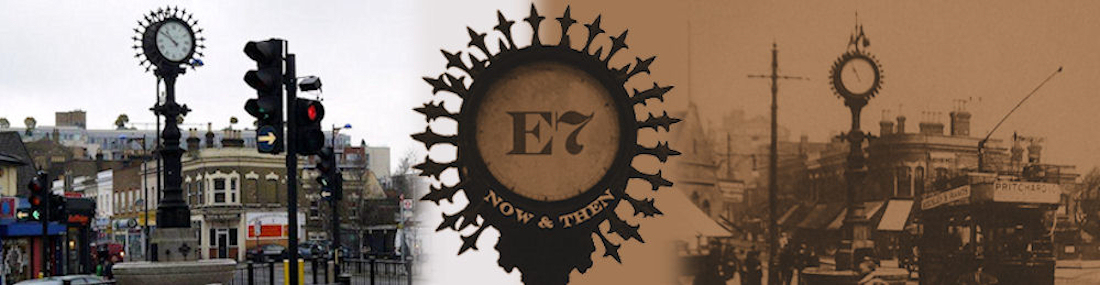
Forest Gate Clock Tower and drinking fountain


Perhaps the district's best known and widely shared image. It was erected by the Metropolitan Drinking and Cattle Trough Association (see above, and the Gurney connection), following a donation by A Corbett around the turn of the 19th/20th century.

The Gurneys had already sold the land on what is now the Woodgrange estate to Thomas Corbett in 1877 for £44,000. On Thomas' death in 1880, his son Archibald took over the development of the estate, until he left to pursue a career as a Liberal politician in Glasgow, around the turn of the century.


1908 postcard, showing original location
 of the Forest Gate Clock Tower and drinking fountain
The clock/trough/fountain is the only public reference to the Corbett family left within the area: the name "A Corbett" can be seen engraved on the base of the structure.

It has been moved at least once in its 120 year existence, as can be seen from its positioning in the 1908 photograph above.


West Ham synagogue memorial, Earlham Grove


Firstly, the road on which it is located.  It was named after Earlham Hall, the Norfolk country house in which, yup, Samuel Gurney, was born. The road was built on former Gurney land.

We have covered the history of the local Jewish community, which was concentrated in and around Earlham Grove,  in some detail here.

There was a synagogue at 91 - 95 Earlham Grove throughout the entire twentieth century.  Attendances, however, dropped considerably after the movement of much of the local Jewish community into Essex, following the extension of the Central Line after World War 11. 


West Ham synagogue memorial,
 Adler House, Earlham Grove
The house of worship, almost inevitably, closed as the active congregation dropped to barely a couple of dozen, in 2004.

Following its closure, some remnants were salvaged from the building and turned into a small memorial in the courtyard of Adler Court, the social housing project that was built, to replace the synagogue. 

The housing development was named after a prominent local rabbi and the memorial incorporates the star of David that was prominent on the frontage of the building's Communal Hall, as well as plaques commemorating the opening and extension of the synagogue.

Underneath the Arches - Sub- trainian Forest Gate!

Tuesday, 26 April 2016


 We have covered the history and route of the Gospel Oak to Barking over-ground rail line(GOBLIN)  through Forest Gate on this site before (here). It was constructed amid much controversy and protest locally, as its construction involved knocking down a number of relatively recently built, and much needed, houses, over 120 years ago.

To minimise the house demolition programme, much of the route was built across a series of viaducts, which resulted in an elevated track, giving it the nickname the 'Chimney Pot Line'. The viaducts, in turn, created over 100 railway arches along the short stretch of the line that passes through Forest Gate, alone.


GOBLIN, or Chimney Pot Line, route
 as it meanders through Forest Gate
These arches have traditionally been either left vacant, offered passageways - as in some of the section on Woodgrange Road - or have been rented out, typically to metal-bashing workshops, car body repair shops or storage depots.

Many are currently boarded up and unoccupied, while others are vacant, having recently been refurbed  and open for leasing at ever-increasing rents.

Gradually, changes in function are beginning to take place, as property prices in the area generally have soared, and the once shunned arches are now offering relatively cheap locations for a number of local enterprising service-sector businesses.

This post offers a quick glance at some of the more interesting ventures that have cropped up in recent years as the GOBLIN meanders through Forest Gate. They are unlikely to be adversely affected as the line shuts down for 8 months major refurbishment later this year.

The map, above, shows the route and the rest of this blog looks at some of the more unusual businesses operating underneath the arches.  We are taking a generous interpretation of Forest Gate's area, and tracing the line from Woodgrange Park station, on Romford Road, through Wanstead Park station till it leaves Cann Hall Road on its journey to Leytonstone High Road.

Hampton to Balmoral Roads Four of the more traditional metal bashing/car repair workshops. Nothing of exceptional interest.

Sebert to Lorne Roads Perhaps the longest-established, non traditional, user dominates this stretch: The Old Slate Yard. It is a florist and what is politely referred to as "architectural reclamation yard" (web)

As their website says: 
The Old Slate Yard is a family run business situated in the heart of Forest Gate London. The Yard started 30 years ago buying and selling reclaimed slates, bricks and tiles etc. Since then it has now expanded greatly and now has a beautiful florist catering for all your floristry needs"


Floristry at the Old Slate Yard
 Much the greater part of the yard is occupied by reclaimed building materials - extremely useful for people trying to get an authentically traditional feel for their Victorian house. This is particularly helpful for those living within conservation areas (like the Woodgrange estate) where materials, such as this firm supplies, are often specified for those seeking planning permission for major works to the houses.


More traditional reclamation
activities at the Old Slate Yard
The firm's website and more recent initiatives within The Old Slate Yard have, however, focused more on the firm's floristry and gift offers. This is probably a generational thing within the family running the Yard. It is to be hoped that the traditional side of the business does not fade away as time moves on.

This section of the arches also houses a fast-food storage depot.

Latimer Road Less interesting: there are three storage arches and three car repair workshops occupying the arches along this stretch.

Cranmer Road Milma Foods (web)is an  Asian food manufacturer,  registered in Manor Park. It occupies three arches along here. It  produces and stores mixes for Dosa/ Wet Idli. According to the company's website it is "The leader" in the production of these mixes in the U.K . and supplies them  to hotels and catering establishments in Britain and elsewhere.


Milma's famous mix
On the opposite side of the road is an ally, hosting 15 units, many recently refurbished by Network Rail, running behind Woodgrange Infants school, to Avenue Road.

While most of these are the traditional car repair workshops, two recently occupied ones catering for the sport/fitness/wellness sector have popped up.

These are MBox  - a boxing and martial arts gym (web). According to its website: 
MBox Forest Gate is a specialised boxing, martial arts and performance training space in the heart of East London's historic boxing scene.


Phoebe Wynne-Jones, of MBox
Founded by Forest Gate local and professional boxing coach, Mickey Cunningham, and nutritionist/trainer Phoebe Wynne-Jones, MBox provides a relaxed positive environment, open to all levels from novice to pro. We focus on health and well-being in conjunction with a sense of community and good vibes.
Mickey Cunningham of MBox
The company offer twenty hours of classes per week.  Fuller details, and prices are available on the website.

The second is a yoga studio: Space East (web). According to its website:
The aim was simple... An inclusive studio, a welcoming space where everyone, no matter your shape, size, fitness level, age or ability, feels valued, capable and comfortable... however with a certain amount of healthy challenge!! 
Fitness class at Space East
Our aim is to provide an aesthetically pleasing place in which to keep fit and healthy. But most of all a space to enjoy and have fun. Here at 'The Space East' we include everyone, the young, the old, the bendy Wendy's and the not-so-flexible!
 It is a space we have created for you and we would welcome your thoughts. We value any suggestions you may have that would enable us to help you, and the people you love feel included.  
We really hope you enjoy 'The Space' 
Avenue - Chestnut Roads The half a dozen or so units along this stretch are currently out of service and operation and don't look like they will be hosting businesses any time soon.

Wanstead Park station There are nine arches here, running underneath the station platforms and track. There is an interesting selection, including a kitchen warehouse and builder's merchants, an embroidery workshop, a mobility-car sales depot and a unit offering courtesy cars as replacements for those damaged in accidents.


Wanstead Park station in 1967,
before major railway arch development
Recently installed up-lights on Woodgrange Road
 pavement, providing safety and increased
 attraction to the area
.
Bignold Road There are four car repairers/metal bashers along the section.

Strode to Station/Winchelsea Roads (arches 350 - 379) This is the most interesting and diverse sections of sub- trainian Forest Gate. A latter-day, older and less frenetic  Ian Drury may be tempted to pen a ditty entitled "Sex aids, and Folk and Alcohol" to describe it.

Unlike many of the other sections featured in this article, the majority of the units are in a row running parallel to, and having direct access off, a public highway - thus have a much more visible and accessible public presence.

The strip features half a dozen car and motorbike repairers and dealers and a small number of units which are currently to let.  In addition, there is an extensive construction company depot and firm specialising in 'structural architecture': RSJs and the like. There is also an insurance brokers along this stretch.

The more recent, and possible more interesting additions, include:

Sh! This is a  relatively large building and, apart from a sign simply announcing its name, fairly anonymous and incongruous looking. It is, in fact, the mail order headquarters of one of Britain's biggest sex-aid retailers. The company's HQ is located in similarly anonymous premises, just across the road; it once had two retail outlets (now just one) at fairly up-market London addresses.

Contrary to the impression in the company's name, it has much to shout about.

The firm is extremely woman friendly, and indeed some of the floorspace in its retail outlets has been women only access, and other parts are only open to men if accompanied by a woman.


Sh! - but quite a lot to shout about
It's website says:
When Sh! was launched, way back in 1992, we'd no idea would it would be a journey that would alter the face of the British sex industry forever, inspire change and bring respect and focus to female sexuality. We simply wanted a place we felt happy to shop in. From our first trip around Soho sex shops, to being taken to court, discovering Jessica Rabbit, introducing sex toys to the NHS and launching Cafe V .... we have an interesting history.
Strange how our little area of East London: with Sh! and the sex shops empire of West Ham FC owners, has turned out to be the sex-aid hub of the UK.

Hawkes (web) This is an exciting venture that opened last year, whose progress we have noted in passing in our articles on the local food and drink scene (see here, for an example). It is a relatively new ginger beer and cider-making company, brewing on the spot, but specialising in using London grown apples - thus taking sustainability a step further than most.


Hawkes: setting out their stall
The firm, intriguingly, has a "supply and return" offer, whereby local growers who donate apples in the autumn are paid for their troubles with bottles of cider made from previous brewings!

The company also hosts great Cider and Pizza nights at weekends, where freshly, oven cooked pizzas are made, on site, by the great Lupollo pizza firm of Wanstead.

The staff are incredibly friendly and a great time can be had there.  Highly recommended!

Brettells (web) We have covered this company before (here), which has recently returned to its Forest Gate original home, after an extended stay in workshops in Chestnut Road. The firm of wood turners and works has a long tradition, being able to trace its origins to Huguenot settlers and Hackney workshops.

Wanstead Tap (web) After years of selling craft beers on farmers' markets, Tap entrepreneur, Dan Clapton, took a giant leap forward a couple of years ago and opened up "underneath the arches".  As such, it was a risky step, but one which seems to be paying off, with his unique offer.


Tap logo
The Tap is open most afternoons and evenings at weekends. The afternoon offer is mainly as a child-friendly cafe, although the great attraction for many, both then and particularly in the evenings is the extensive range of 80 - 100 craft beers and ciders.

The Tap is making a name for itself with its exciting and eclectic social evenings.  These are a bit sporadic, depending on the availability of guests etc. But, the 70-odd seater venue can often be found hosting book launches, in conjunction with Newham Bookshop and comedy nights, with well-know figures (Alexei Sayle and Bob Mills come to mind).

There are also fascinating "evenings with" interesting people, iconic folk musicians, and managers and support and promotional staff associated with major entertainment stars.


Setting up for another busy
 night at the Wanstead Tap
Open times are erratic. Drinking and entertaining times are good.

Aphrodite's (web) Aphrodite Fingal-Rock Innes (nickname: Dixie, pictured, below) and William Powell launched Aphrodite's in 2015 - a venture which emerged from a shared passion for Middle Eastern food, and a common childhood base in South Wales.

Dixie is a chef and finalist in Channel 4's The Taste. The two owners are innovators and their recently launched, unique Pomegranate Ketchup seems to be proving a big hit.


Dixie - the face of Aphrodite's
The pair operate a street food outlet, from the back of a Citroen van at weekends in Maltby St Market, and during weekday lunchtimes at different City locations.

Maltby St, in Bermondsey is a little jewel: it has developed rapidly over the last couple of years by young food suppliers priced out by the more established Borough St market, near-by, at London Bridge.


Maltby St - haven for those
 priced out of Borough Market
Check Maltby St and Aphrodite's out - you won't be disappointed!

Thorpe to Cann Hall Road This stretch hosts half a dozen metal bashing/car repair shops and a number that are currently vacant, or boarded up. There is also a scaffold company, toy and tool wholesaler and a car wash arch.

In keeping with the recent focus on sports and exercise, there is also a longer-established Karate school (web) It seems to have been running for about four years.

According to its website:
Okinwan Karate School (OKS) is a professionally run, independent family Dojo (ed: room where Karate and other martial arts are performed) at the heart of East London, in Forest Gate. It is fully kitted and offers a variety of classes.
 OKS specialises in teaching Karate to children between 4 and 16 years only, and although adults are not accepted entry level, children who start with OKS can remain with the team into their adult Karate training lives.


Youngsters at Okinwan Karate School
And just next door; another strange unit: Christ Embassy, Forest Gate - a black evangelical church.

Overall
These sub-trainian units, between them, probably employ 300-400 people, and as such, collectively represent the largest number of non-public sector jobs provided in Forest Gate, today.

Some of the unit holders are complaining at the rapidly increasing rents being charged by Network Rail for them - particularly after refurbishment. The rail landowners are obviously waking up to the considerable commercial opportunity their trains rumble over.
  
Anyone interesting in leasing one of the 20 or so vacant units in Forest Gate should contact Network Rail, on 0800-830-840,in the first instant.