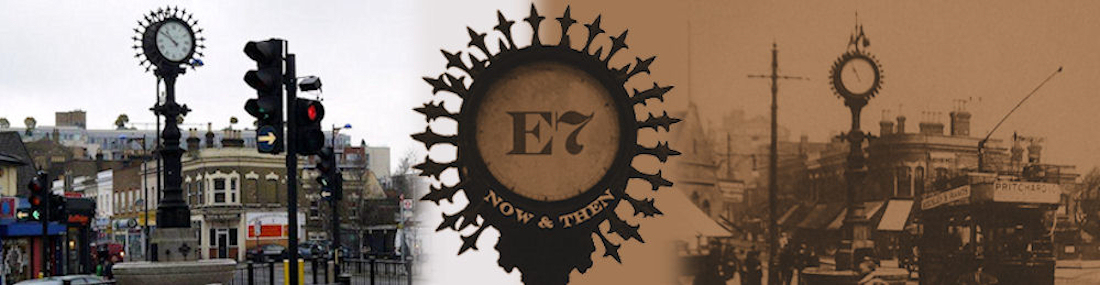
What, a century ago, was Forest Gate’s thriving
shopping centre (see here) and here) on Woodgrange Road, is planned to be host
to over 300 new or refurbed flats on four different sites. We’ve reported on
some of these developments before, but now – five years later – we bring the
latest on the status of Warden’s Reach (the old Barry’s block), Durning Hall,
the Methodist church and Donald Hunter House.
Recently there has been, or soon will be, significant
changes in the ownership and status of each development, but relatively little
concrete evidence of real progress in providing new homes for people, in all but
one of them.
Warden’s Reach (39a-49a Woodgrange Road)
This project has been considerably delayed since
planning permission for it was first granted in 2017 (see here) to developers,
London Ironworks, who planned the site as a private, commercial development.
Originally scheduled for construction in 2018-2019, it is, four years on, only
now nearing completion.
Having gained planning permission, London Ironworks
sold it on to Gateway Housing Association for an unidentified sum. Gateway made
some changes to the proposal reflecting its new status as a social housing
project, and then sold it on to Latimer Homes – another social housing provider
- and part of the Clarion Group, the country’s largest owner of “affordable
homes”. Clarion has a history stretching back to the 19th century,
when its founder, William Sutton, bequeathed what would be £230m in today’s
terms for the construction of “affordable homes”.
The nearly-completed Warden’s Reach comprises of two
blocks, Holly House and Epping House, which between them consist of 78 flats –
a mix of one-bed, two-bed and three-bed units. They are mainly of the
shared-ownership model, the purchase of which is largely restricted to first
time buyers with relatively modest incomes.
Typically, purchasers will “buy” 25% of the value of a
flats and “rent” the other 75%, with an option to purchase a larger share, over
time, as their income allows. This could mean initially finding a deposit of 5%
of the total price, borrowing 20% on a mortgage and paying rent for the other
75%.
 |
Warden's Reach - nearing completion
|
Although branded as “affordable”, prices are not cheap.
The full price of one-bed flats is between £364k-£372k, of two-bed apartments
from £480k - £632k and for the three-bed accommodation, £665k.
It would cost £158k, up-front, to secure the initial
25% purchase of a typical £632k 2-bed flat. The monthly outgoings would then
likely be £2,050, consisting: £950 mortgage repayment, £850 rent (for the 75%
not purchased) and £250 service charges.
The flats are being sold via a pop-up estates office
on Woodgrange Road, facing Sebert Road. According to the Warden’s Reach website
about a third of the flats were sold within the first two months of them
becoming available for sale.
The ground floor of Warden’s Reach is for retail and
Latimer has recently sought a purchaser of it, for around £5m. The company has
already secured a 30-year lease with supermarket chain Lidl for the greater
part of it, with a shorter lease to Costa, for a coffee shop and a very short
lease to a local retail beauty outlet. The retail units are expected to be up
and running by April this year.
Donald Hunter
House
This is the
eight-storey pink-clad building at the foot of Woodgrange Road, above the library
and Iceland store. Following WW2 bomb damage to the area, the Post Office constructed
an office block in 1958, Telephone House, as a sub-regional headquarters
of their then telephony arm. Following restructuring and privatisation of the
telephone service - rebranded BT - the building became surplus to requirements
and was sold off in 1999. We have previously featured this property here.
 |
The old Telephone House
|
It was bought
by Peabody Unite plc (a joint venture between the Peabody Housing Association
and the Unite Group, providers of key worker and student accommodation) to
provide accommodation for upto 256 key workers (mainly hospital and education
staff), and renamed Donald Hunter House, after a local well-known doctor.
The
accommodation was poor, cramped, expensive and inconvenient for hospital staff getting to
work, so they sought other more suitable and often less expensive accommodationthe
elsewhere. As a result, it was under-occupied. In 2014 Newham council was
subject to two court judgements. One accepted the fact that the building was
unsuitable for children, because of its
lack of communual play facilities. The other forced the council to introduce a
variation in designated usage, to effectively permit the property to house economically
inactive homeless families!
The
accommodation was subsequently purchased by an off-shore company, Guernsey-based
Stratos Holdings for £15.7m. As an
off-shore entity, it is unlikely to pay UK taxes on its earnings. Stratos is, in turn, owned by a huge Luxembourg-based
company which specialises is property acquisition, the ownership of which is
also “off-shored”, to avoid tax liability.
That
Luxembourg company - Grand City Properties S.A. – is one of the largest
residential property companies in Europe, with over £11bn in assets and profits
in excess of £600m in 2021 alone. The founder of this is Yakir Gubay, who has a
net worth of £3.7bn, and according to Forbes, is the world’s 785th
richest man.
Stratos
sub-let Donald Hunter House to Omega lettings, itself a subsidiary of a company
called Tando, a commercial company which specialises in supplying accommodation
to local authorities in which to house homeless families, at some profit to
themselves.
 |
Donald Hunter house, above the library and Iceland
|
Because of a
quirk in funding arrangements, Tower Hamlets council is able to pay more rent
to the landlords for this type of accommodation than Newham, so Omega let the
property to them, with Newham having to pick up the social care and education
costs of its Tower Hamlets homeless residents.
Omega charged local
councils upto £70 per night to house families there in totally unsuitable accommodation.
Despite this, hosting councils (Newham in this case) have fewer rights to clamp
down on unhealthy and environmentally unsound conditions in properties like
Donald Hunter House than they do in regular private or socially rented
accommodation. Children are forced to live in properties with broken lifts and
stairwells hosting drug use and other anti-social behaviour and there is little
the local authority can do to impose improvement orders on the owners/managers.
Following
Grenfell in 2017 Donald Hunter House was identified as a vulnerable building
and remained so, untreated, for a further two years.
Donald Hunter
House, unsurprisingly, gained a poor reputation, and attracted adverse press attention,
for having inadequate and cramped facilities, sub-standard maintenance and poor
public hygiene (vermin and flea infestation etc.).
In an effort to address all of these unsatisfactory
conditions, Newham Council purchased the property in June 2023 for £31m - twice
the price Stratos paid less than a decade earlier. Stratos incurred no Capital
Gains Tax liability (a saving of over £3m), because of its off-shore status. Newham’s
purchase, however, gives it the ability to house its own rather than Tower
Hamlets’ homeless families in the block, for the future.
Newham has
subsequently committed £1.4m to address some of its most pressing needs
(damaged windows and roof etc) and improve the lot of its residents. This expenditure
is not sufficient to enable a full refurbishment of the block, that may await
the outcome of the council’s consideration of potential longer-term full redevelopment
proposals, but should ensure more satisfactory accommodation for the families
living within it.
The homeless
families living in Donald Hunter House are often targetted for public absue as
scroungers etc, while its long term owners (Stratos/Grand City) and site
managers (Omega/Tando) have provided
sub-standard accommodation and remain largely hidden behind a complex web of
ownership, to extract millions in tax-free profit from the public purse.
Donald Hunter
House is not unique in Britain, it is symptomatic of a wider issue. Local
authorities in the UK spent £1.7billion on temporary accommodation in 2021. The
profiteering within the sector by firms like Omega/Tando/Stratos/Grand City is
a direct consequence of the contraction of social housing in the country over
the last four decades.
(We would
like to thank Lea Sitkin, a local resident and Social Scientist at Westminster
University, for help with this section of the article. If anyone wishes to
reach out and talk about temporary accommodation, she would be pleased to hear
from you. She can be reached via L.Sitkin@westminster.ac.uk or via X (Twitter):
@LeaMarikeSitkin)
Woodgrange Methodist church
This blog reported on the redevelopment proposals for
the now-derelict church here, in March 20218. The original church was built on
the site towards the end of the nineteenth century, but was destroyed by
bombing during World War 11 (see here). It was subsequently rebuilt in the
1950’s but later faced a large turnover in membership with differing demands from
the congregation for the buildings – to become less formal and more
multi-purpose.
 |
The church before the hoardings went up
|
The Methodists, at a local and national level, began
discussions over a decade ago on plans to redevelop the facility. They quickly
concluded that the only way to pay for the modern multi-purpose, flexible
church building they wanted would be to reduce the footprint of the church
itself and build flats on the rest of the site. As we reported in 2018, Pigeon
Investment Management – a Suffolk based company established in 2008 - agreed to
develop the site and appointed Alaistair Watson of Broadchurch Asset Management
to undertake local consultations for their proposals.
Pigeon established a subsidiary company, which later became
Pigeon (Forest Gate) Ltd. This currently has two directors, William Stanton one
of the founding directors of the parent company, who is a director of 33 other
companies, some within the group and others not and Andrew Boyce, who appears
to hold 50% of the shares in the Forest Gate company, He is not a member of the
main Pigeon board, but is, however, a director of 32 other active companies.
Watson of Broadchurch, as we noted in 2018, was an
unconvincing and poor advocate for both Pigeon and the proposed development. He told us that planning permission would be granted within 2-3 months and
construction would take upto 18 months, meaning that the new flats and church
would be open for business in early 2020! Four years on, we are waiting for the
first brick to be removed from the old building.
Companies House records show that Watson has been
associated with 45 companies over recent years; 18 have been dissolved, he has
resigned from a futher 23 and is only currently active in the remaining four.
The Methodists’ and Pigeon’s proposed redevelopment
sought to relocate the church building to the Osborne Road end of the site and
build around 33 flats on a block reaching six stories high, at the Claremont
Road side of it.
 |
How the developers saw the site, post construction
|
The church itself was to feature a high spire, which
would accommodatethe relocated Grade 2 listed Peter Peri statue of the “The
Preacher” which currently adorns the wall of the existing church.
There was a great deal of to-ing and fro-ing between
the developers and council over the proposals – extending to in excess of 150
documents - before planning permission was eventually granted in July 2020.
This substantially agreed to the original proposals, but reducing the number of
flats to be built to 31 and ensuring that there was a wider range of sizes of
flats on the development.
The abandoned church has subsequently attracted
squatters, anti-social behaviour and has been affected by at least two fires.
In an effort to reduce this activity, hoardings have been placed around it for
the last three years.
And they have not been productive years, as far as the
site has been concerned,
We spoke to William Straton, the main Pigeon director
associated with the Methodist church project. He told us that Pigeon pulled out
of the deal about 18 months ago, because the numbers ceased to stack up for
them. He said that the original deal was tight, in affordability terms, and
that subsequent price rises in building material costs and interest rates had made it an
unattractive project for them. He also indicated that the Methodist church had
been difficult to deal with and that the project was one that with hindsight he
regretted his involvement with.
 |
A CGI view from on high
|
Pigeon (Forest Gate) Ltd remains an active company and
he is still its main director. It is, however, sitting on considerable losses
incurred during the planning process for the Methodist church. The intention is
to use this company as a vehicle to manage another, profit- making deal, change
its name and offset those accrued profits against the Woodgrange Road losses.
This is all perfectly lawful.
The approval for the planning application for the site
expired in July 2023 and the planning department has confirmed there has been
no new application for the site, nor a request to grant an extension for the
original approval. All of which means that a new set of proposals will need to
be submitted to permit any development on the site at all. That could be a
lengthy process, given the requirement to undertake local public consultation
for any new plans.
Meanwhile, Broadchurch, the company that undertook the
first consulation, was liquidated in December 2023 at the request of its
creditors, among which is HMRC, which was owed in excess of £100,000 by the
company.
We spoke with the Methodist church at its London
District level and its has a new property manager who was able to confirm that
there are currently no plans for the site, in terms of its immediate
development. The church at local, regional and national level will “soon” be
undertaking discussions to help determine its future.
This could clearly take some while; there then may be
the disposal and sale of the site outright, or the appointment of developers to
come up with new proposals for a new scheme, which in turn would need planning
permission and a construction period.
So – we are looking at a likely minimum of five years
before anything approaching a solution can be delivered for this eyesore. All
highly undesirable for local residents, who will have suffered a Methodist
shaped blot on the Forest Gate landscape for upto 15 years.
Durning Hall
Durning Hall is run by the Aston Mansfield charity,
which has been in Newham for over 130 years, catering mainly for the needs of
families and children. We have covered the history of Durning Hall on this site
before (see here). The Hall and associated buildings are yet another
post-war Forest Gate development in desperate need of replacement or renewal.
Its website says that “without significant work, the site is financially
unsustainable.”
 |
Durning Hall - financially unsustainable
|
The trustees of the charity hope that its
redevelopment (running from the corner of Earlham Grove to, but not including,
the Post Office delivery office, and along Woodgrange Road to, but not
including, the Co-op) will mean that the charity can continue to work in
Newham, providing resources to help it to support children, young people and
families within the borough. As with the Methodist site, the theory is that the
income raised by the residential development will pay for the not-for-profit
work they wish to continue.
Following extensive consultations by Durning Hall, both
before and during the pandemic, Newham council has granted planning permission
for revised proposals for the site’s redevelopment. Durning Hall’s website
states that they wish to “redevelop the site in partnership with an
organisation with development expertise” and hope to appoint such a company by
April this year. The expectation is that once started, the construction work
will take at least three years.
There are indications that planning blight for the footprint of the site has already kicked in. Just this week, Malchem the chemists' was forced to vacate its premises and move 150 yards further south on Woodgrange Road, because Durning Hall would not grant them a lease extension. Whether the now vacant shop stays boarded up or becomes host to pop up shops remains to be seen, but the writing is on the wall and no building within the perimeter of the scheme is likely to experience a facelift until construction work commences.
It is to be hoped that Durning Hall apply greater due
diligence and find more suitable partners than the Methodist church has, to
date, for its Woodgrange Road building, or completion could be a long way off. The charity is at least more realistic
in providing times scales for construction and completion of the project.
 |
Tired looking shops on Woodgrange Road - to go!
|
The proposals are to construct 78 high quality homes,
including 27 (35%) “affordable” ones – though no indicative prices for any have
yet been supplied. They also include provision for community facilities, incorporating
a “Youth Enterprise Pop-up Space” a creative children’s playspace and four shops
on Woodgrange Road, to replace those eight that will be demolished.
Although the Co-op and delivery office are not
included in the plans, Newham has already designated those sites for
re-development. It seems possible that once Lidl has opened 100 metres away,
the Co-op will struggle to remain viable, which could will trigger a sell on of
the the shop for further development. The delivery office has already been
earmarked for sale and redevelopment by the Post Office – a company in
desperate need to raise money to pay the costs of its scandalous treatment of
sub-postmasters.
 |
CGI view of how the development will look from Woodgrange Road
|
The extensive consultations around Durning Hall’s
original accommodation proposals resulted in some modifications to them, which
laid the basis for the planning consent granted. Originally Durning Hall wanted
a 12-storey building on the site. That has been scaled back to a 10-storey,
maximum, building on Woodgrange Road, gradually reducing to six storeys on Earlham
Grove.
 |
The view from Earlham Grove
|
The 78 homes will consist: 4 studio flats, 23 one-bed
flats, 35 two-bed flats and 16 3-bed units. There will be a communual courtyard
and a designated play area for 5 – 11 year olds. The development, consistent
with council conditions, will be car-free, except for 3 disabled parking bays.
There will, however, be a significant amount of cycle parking space.
There is no indication, at this stage, of the likely
costs of the new flats that will be built.
Conclusion
The fate of some of these developments over the last
decade has been almost a metaphor for the state of the country over the period.
An essential need for all people has been hijacked by a combination of absentee
greedy tax avoiding speculators and incompetent or ill-suited developers,
fiddling and delaying in the pursuit of gain to the detriment of the local
public realm and basic human requirements. It is to be hoped that the same fate
does not befall the Durning Hall site.